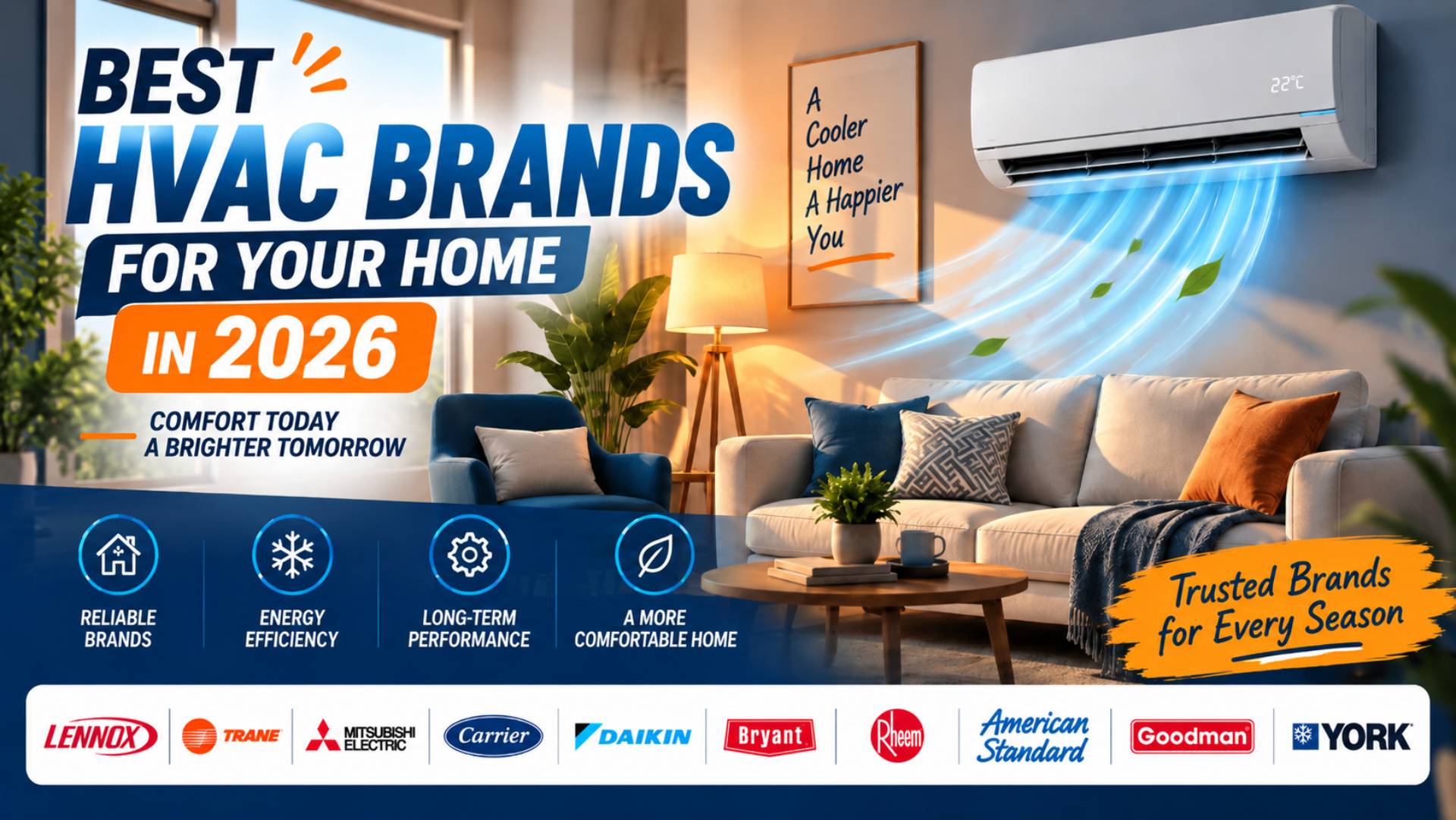
Most “best HVAC brand” lists compare names without telling you that several of them are the same company selling the same engineering under a different badge at a different price. This guide doesn’t do that quietly — it groups ten major residential brands by price tier, the question most homeowners are actually asking, and discloses corporate ownership wherever two brands on the list share a parent, so you can see when “shopping around” between two names is really a discount, not a different product. For homeowners researching best HVAC Brands 2026, understanding those ownership relationships can be just as useful as comparing efficiency, warranties, and product ranges.
This is built for homeowners and property managers comparing central air conditioners, heat pumps, furnaces, or ductless mini-splits for a home, working with a contractor to choose equipment.
Nothing here was hands-on tested by our editorial team — no unit was installed, run, or field-tested. Every claim is drawn from each brand’s own product and warranty pages, corporate history, and named reviewer sources for price-tier characterizations, checked in early September 2026. Efficiency ratings, warranty terms, and pricing tiers change; confirm current details with the brand or an installing contractor before you buy.
👉 Key Takeaways
- This guide does not rank HVAC brands from 1 to 10; instead, it groups major residential brands by price tier so homeowners can compare premium, mid-range, and budget options more realistically.
- Corporate ownership matters more than many buyers realise, since several well-known brands are sibling lines under the same parent company, including Trane and American Standard, Carrier and Bryant, and Daikin and Goodman.
- Efficiency comparisons should focus on SEER2 and HSPF2, not older SEER or HSPF ratings, because the U.S. moved to the newer testing standards in 2023 and older figures are not directly comparable.
- Premium brands tend to lead on performance and efficiency, while value brands often appeal on price and practicality, making the right choice dependent on budget, system type, and installer support rather than brand name alone.
- Warranty terms, model specifications, and even ownership can change quickly, so buyers should treat all figures as time-sensitive and confirm current details directly with the manufacturer or installing contractor before making a final decision.
Table of Contents
How These Ten Were Chosen and Grouped
That distinction matters when comparing top residential HVAC Brands, because sibling lines can share platforms while differing in price, warranties, and dealer networks.
📌 Editorial Methodology : This comparison was independently prepared for informational purposes. Theme providers did not pay to determine their position in this list. Some links may be affiliate links, which means we may earn a commission if a reader makes a purchase, at no additional cost to the reader. Affiliate relationships do not affect our selection criteria or editorial conclusions.
Several well-known HVAC “brands” are sibling product lines sold by the same parent company on shared platforms, differentiated mainly by price and dealer network. This guide includes some of those siblings because each is marketed and sold as a distinct option a homeowner will actually be quoted — but every such relationship is disclosed here, plainly, rather than presenting the brands as fully independent competitors:
Trane Technologies owns both Trane and American Standard, and co-owns Mitsubishi Electric’s U.S. residential business through a 50/50 joint venture called Mitsubishi Electric Trane HVAC US. Carrier Global Corporation owns both Carrier and Bryant. Daikin Industries owns Goodman and the Daikin residential brand itself, plus a third sibling, Amana, which isn’t given its own entry here since it occupies very similar budget positioning to Goodman under the same parent. Lennox International and Rheem, a subsidiary of Japan’s Paloma Industries, are the two brands here without a sibling on this list.
York changed hands during this research: Johnson Controls sold its residential and light-commercial HVAC business, including York, to Bosch in a deal that closed in August 2025. “YORK” is now a Bosch-operated trademark licensed from Johnson Controls. Given how recent that is, treat York’s entry as more likely to be in flux than the rest of this list.
One finding worth flagging up front: during research, we couldn’t verify a current EPA ENERGY STAR Partner of the Year award, or any dated, verifiable J.D. Power residential-HVAC-equipment-brand ranking, for any of the brands covered here. Several brands’ marketing references such recognitions, but the ones we could trace were stale — one Lennox reference dates to 2007 — or self-reported without an independently checkable source. If a brand claims a current #1 J.D. Power ranking elsewhere, it’s worth asking for the specific, dated study, since J.D. Power’s best-known public HVAC-related studies cover vehicle climate systems, not residential home equipment brands.
The U.S. moved to new SEER2 and HSPF2 efficiency test metrics starting in 2023; a rating under the old SEER or HSPF scale isn’t directly comparable to the new one. Current SEER2/HSPF2 figures are used here where published, with one exception flagged below. Every efficiency figure is the highest confirmed for that brand during this research — not necessarily every model in the lineup.
Unlike consumer software, no brand here publishes retail equipment prices — HVAC systems are sold and installed through independent contractors, and installed cost depends heavily on region, ductwork, and dealer. So instead of a dollar figure, each entry below gives the brand’s price tier as characterized by named reviewers, not a number we calculated ourselves.
Premium Tier
Lennox
Lennox International is independent and publicly traded, founded in 1895, and headquartered in Richardson, Texas. Its product line spans central AC, heat pumps, ductless mini-splits, and its iComfort smart thermostat line. Its range across central AC, heat pumps, and ductless equipment makes it relevant when comparing the best Heating and Cooling Systems for different types of homes.
One discrepancy worth knowing: Lennox’s consumer-facing pages for its flagship AC, the SL28XCV, still publish only the legacy “up to 28 SEER” rating rather than the current SEER2 metric. The SEER2-equivalent figure — 25.80 SEER2 — is published on Lennox’s dealer-facing portal rather than its main consumer site. Its SL25XPV heat pump is listed at up to 22.2 SEER2 and 11.2 HSPF2 on that same dealer portal.
Warranty coverage varies by product tier. Its top Signature Collection carries 10-year parts, 10-year compressor, and a limited-lifetime heat exchanger unregistered, extending to 12-year parts-only if registered within 60 days. Mid-tier and entry series carry shorter base terms with similar registration extensions. Residents of California, Florida, Georgia, and Quebec get the extended terms automatically, since those jurisdictions restrict registration requirements.
On the ENERGY STAR front: Lennox’s own site references a “Partner of the Year” award, but the linked press release dates to 2007 — roughly two decades stale — and no current listing could be found. Reviewers at outlets like This Old House and Forbes Home both characterize Lennox as premium, citing its high efficiency ceiling alongside a correspondingly higher price.
Trane
Trane is a brand of Trane Technologies; the name traces to an 1885 plumbing shop, with the modern parent’s lineage running through Ingersoll Rand’s 2008 acquisition of Trane and a 2020 rename after divesting its industrial businesses. Its global headquarters is in Dublin, Ireland, with North American headquarters in Davidson, North Carolina. Its product line spans central AC, heat pumps, ductless mini-splits, and smart thermostats.
There’s a same-site inconsistency worth flagging: Trane’s own flagship AC, the XV20i, is titled “21.5 SEER2” on its product page, but a separate Trane blog page for the same unit states “22-SEER” — the legacy metric, not SEER2. A distributor listing selling genuine Trane equipment corroborates 21.5 SEER2 for the AC and 20.5 SEER2 with 8.7 HSPF2 for the equivalent heat pump, but this is worth a direct, manual re-check before treating it as settled.
Warranty coverage is 5-year parts “in most cases,” extending to 10-year parts “in most cases” if registered within 60 days of install — Trane’s own phrasing leaves room for model-specific exceptions it doesn’t spell out. Reviewers at This Old House and Forbes Home both describe Trane as one of the most expensive brands in the category. Warranty coverage, dealer support, efficiency, and model-specific performance are all worth considering when comparing reliable HVAC Brands for homes.
Mitsubishi Electric
Mitsubishi Electric’s U.S. residential ductless business is sold through a 50/50 joint venture with Trane Technologies called Mitsubishi Electric Trane HVAC US, formed in 2018 — meaning this brand shares a corporate parent, in part, with Trane and American Standard. Mitsubishi Electric introduced ductless technology to the U.S. market in 1982, well before the joint venture existed; the venture is headquartered in Suwanee, Georgia.
This is a ductless and heat-pump specialist — single- and multi-zone wall units, ceiling cassettes, and ducted air handlers. It doesn’t sell conventional gas furnaces or packaged rooftop units for residential use. That specialist focus makes Mitsubishi Electric useful to compare with broader residential Heating and Cooling Brands when ductless zoning or heat-pump performance is a priority.
Its FX-Series single-zone Hyper-Heat system is listed at up to 35 SEER2 and 13 HSPF2 by an authorized reseller citing the manufacturer’s spec sheet — worth confirming directly with Mitsubishi before treating as final, since it wasn’t independently verified on the manufacturer’s own site during this research. Its wall-mounted MSZ-WR line is listed separately at up to 18 SEER2 directly on the manufacturer’s site.
Warranty materials reference a 12-year warranty on parts and compressor for residential product, though the underlying registration deadline and exclusions weren’t fully verified in this pass. Comparison sites consistently characterize Mitsubishi Electric as premium within the ductless and mini-split category.
Upper-Mid / Mid-Tier
Carrier
Carrier Global Corporation is independent and publicly traded, founded in 1915 in Syracuse, New York by Willis Carrier. It was a subsidiary of United Technologies from 1979 until spun off as an independent company in 2020, and is headquartered in Palm Beach Gardens, Florida. Its product line spans central AC, furnaces, heat pumps, ductless mini-splits, and its Côr smart thermostat line.
Its Infinity 21 AC is listed at up to 21 SEER2 and 12 EER2; its Infinity 24 heat pump, which Carrier markets as its most efficient, is listed at up to 23 SEER2 and 10.5 HSPF2.
Warranty coverage is 5-year parts as a base, extending to a choice of 10-year parts-only, or 5-year parts plus 3-year labor, if registered within 90 days of install. Forbes Home describes Carrier as more expensive than many alternatives while rating its overall value “good” — upper-mid to premium by that outlet’s read.
Daikin
Daikin Industries is a Japanese public company founded in 1924, headquartered in Osaka, with its U.S. residential arm based in Waller, Texas. Daikin also owns sibling brands Goodman and Amana — see the ownership note above. Its product line spans ductless single- and multi-zone mini-splits, central AC and heat pumps, gas furnaces, packaged systems, and its Daikin ONE+ smart thermostat. Its broad portfolio gives homeowners another useful point of comparison when reviewing top HVAC manufacturers across ducted and ductless system categories.
The highest efficiency figure located on Daikin’s own site during this research was its DX7TC split-system AC at up to 17.2 SEER2 — notably lower than several other brands here, which may reflect the specific model found rather than the true ceiling of Daikin’s current lineup, and is worth confirming directly before publishing a comparison claim. Warranty terms weren’t independently confirmed from a Daikin-specific document during this research.
Daikin’s own materials list several marketing and sustainability awards but no current ENERGY STAR Partner of the Year or J.D. Power ranking. Comparison sites commonly place Daikin mid-to-premium — above sibling brand Goodman, below specialists like Mitsubishi Electric.
Bryant
Bryant is a residential brand of Carrier Global Corporation. Its product line spans central AC, heat pumps, packaged units, ductless mini-splits, and its proprietary Housewise smart thermostat.
Its 291VAN Evolution heat pump is listed at up to 21.2 SEER2, 12.5 HSPF2, and 13.5 EER2; its 191VAN Evolution AC at up to 21 SEER2 and 12 EER2.
Warranty coverage is 5-year parts as a base, extending to 10-year parts if registered within 90 days of installation by the original homeowner; compressor and heat-exchanger terms vary by model. Reviewers generally place Bryant mid-tier, describing it as Carrier engineering at a more accessible price than its premium sibling.
Rheem
Rheem Manufacturing was founded in 1925, is headquartered in Atlanta, and is an independent subsidiary of Japan’s privately held Paloma Industries. Its product line spans central AC, gas furnaces, heat pumps, packaged units, EcoNet smart thermostats, and a “Classic” ductless mini-split line.
Its RA19AY Endeavor Prestige Series AC is listed at up to 20 SEER2 and 13 EER2; a comparable top-line heating figure for its flagship heat pump wasn’t confirmed during this research. That same product carries a 10-year parts warranty and a 10-year conditional unit-replacement warranty with registration required — though Rheem’s general warranty materials don’t spell out the unregistered base term or a separate compressor-only figure brand-wide, so this should be treated as a per-model figure rather than a blanket warranty until confirmed. Model-level ratings like these are especially important when comparing energy-efficient HVAC Systems, since efficiency can vary significantly across products from the same manufacturer.
Rheem’s own site states it received EPA ENERGY STAR Partner of the Year – Sustained Excellence recognition for 2024, its fourth consecutive year — self-reported and not independently cross-checked during this research. A separate “ranked #1” claim on Rheem’s site traces to a 2021 article and shouldn’t be treated as current. Comparison sites describe Rheem as mid-tier with accessible pricing.
Budget / Value Tier
American Standard
American Standard Heating & Air Conditioning is a residential brand of Trane Technologies. The name dates to a 1929 merger; its HVAC business became part of what’s now Trane Technologies through a 2007–08 acquisition. A standalone corporate headquarters for the HVAC brand itself couldn’t be confirmed from a primary source during this research — it’s commonly associated with Tyler, Texas in dealer and employment listings, but that wasn’t independently verified.
Specifications at the individual model level should therefore carry more weight when comparing the best home HVAC systems than the brand name alone.
Warranty coverage is 5-year parts as a base, extending to 10-year parts if registered within 60 days of install. This Old House describes American Standard as consistently the best-value option among Trane-family brands, citing typical savings of roughly $250 to $500 per system versus Trane or Lennox, while sharing core engineering with Trane.
Goodman
Goodman was founded in 1975 by Harold V. Goodman, is headquartered in Houston, and was acquired by Daikin Industries in 2012. As noted above, Goodman shares a parent with Daikin and with Amana, a third Daikin-owned residential brand that occupies very similar budget positioning under the same corporate umbrella and isn’t given a separate entry here.
Its product line spans central AC, gas furnaces, heat pumps, packaged units, and proprietary smart thermostats; a dedicated residential ductless mini-split line wasn’t found under the Goodman brand, as Daikin appears to sell ductless separately under its own name.
Its GSXV9 AC is listed at up to 22.5 SEER2. Warranty coverage, unregistered, is 5-year parts and 5-year compressor; registering online within 60 days of install extends this to 10-year parts, with a lifetime compressor and lifetime unit-replacement warranty on select higher-efficiency models. Residents of California, Florida, Georgia, and Quebec get the registered-level terms automatically. Reviewers consistently characterize Goodman as the budget or entry-level option in the category. When comparing leading HVAC Brands for homeowners, registration requirements, warranty coverage, efficiency, and price positioning should be considered together rather than separately.
York
York dates to 1874. It was owned by Johnson Controls from 2005 until August 2025, when Bosch completed an approximately $8 billion acquisition of Johnson Controls’ and Hitachi’s residential and light-commercial HVAC businesses, including York; “YORK” is now a Bosch-operated trademark licensed from Johnson Controls. Because this ownership change is so recent, treat every detail in this entry as more likely to be out of date than the rest of this guide.
Its product line spans central AC, heat pumps, packaged units, and residential thermostats; a residential ductless or mini-split line wasn’t found, as York’s duct-free products appear to be commercial only.
A YZV variable-capacity heat pump was found listed at up to 19 SEER2 and an HMCG2 AC at up to 16.5 SEER2, though it wasn’t possible to confirm these represent York’s current highest-efficiency models, since the brand’s site was partly mid-migration to Bosch’s domain during this research — treat these as provisional. York’s warranty materials describe coverage as “industry-leading” but specific term lengths weren’t extractable during this research and shouldn’t be published without direct confirmation.
Reviewers commonly place York in the budget or value tier; one reviewer specifically raised reliability concerns tied to coil technology, which is that reviewer’s characterization rather than an independently verified defect rate.
This list isn’t ranked 1 to 10 — brands are grouped by price tier as characterized by named reviewers, and listed alphabetically within each group. Several household names here are sibling product lines from the same parent company, sold at different price points through different dealer networks; every such relationship is disclosed above rather than left implied.
SEER2 and HSPF2 are the current U.S. efficiency test standards, in effect since 2023, replacing the older SEER and HSPF metrics — a rating under the old scale isn’t directly comparable to a SEER2 rating for the same unit. One brand here, Lennox, still shows a legacy SEER figure on its main consumer site for its flagship model.
Treat every efficiency rating, warranty term, and price-tier characterization here as time-sensitive. All of it was checked in early September 2026, and manufacturers change model lineups, warranty terms, and — as with York — even ownership. Confirm current details with the brand or an installing contractor before making a purchasing decision.
When choosing the best HVAC Brand, compare current model specifications, warranty terms, contractor support, installation quality, and the actual heating and cooling needs of your home.